Ever wondered how B2B marketing differs from B2C marketing? Why you can’t just apply the same principles from B2C marketing to B2B marketing and have them work? The answer is because you are dealing with two entirely different market segments.
1. Definitions
B2B stands for “business-to-business”.
B2C stands for “business-to-consumer”.
2. What is B2B marketing?
B2B marketing is defined as being the relationship of marketing products or services to another organisation. B2B marketing requires a lot more finesse in your strategy as you are not persuading a single individual to choose your product over a competitors, but more than likely a whole team of individuals that makeup a purchasing department.
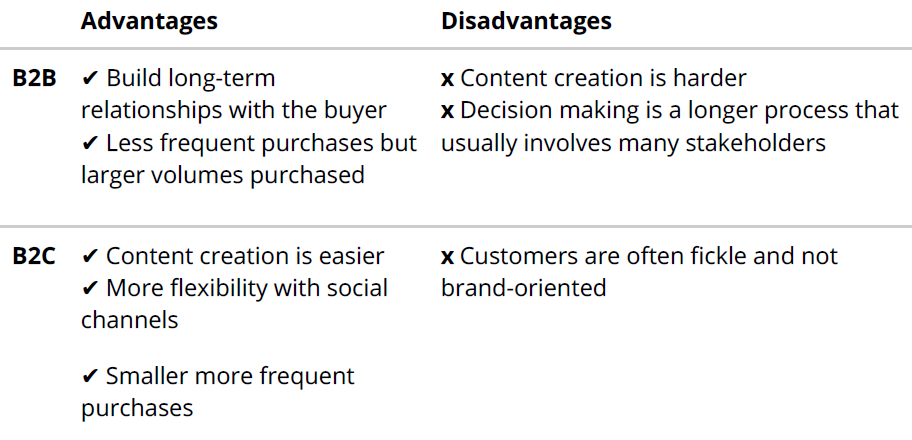
B2B marketing not only involves multiple decision makers but it also involves larger volume purchases and less frequent purchases.
B2B customers want support and reliability from their supplier.
3. What is B2C marketing?
B2C marketing is defined as being the relationship of marketing products or services to the consumer directly. This is the most common form of marketing to consumers. B2C marketing focuses on providing solutions to the consumer’s problem. This can be anything from a new shampoo, a new pair of socks or even sporting equipment.
B2C marketing relies heavily on advertising to place products into the reach of their preferred target markets.
The consumer in the B2C relationship can be flexible to brands if they are price conscious. Purchases occur regularly and the volume of each purchase is relatively small. B2C consumers make quick ‘snap decisions’ on FMCG products (fast moving consumer goods) such as a soft drink, chocolate bar or packet of potato chips. These purchases do not require a great deal of thought to purchase and can be adopted quickly by the consumer.
4. Advantages and disadvantages
5. Quotes and thoughts
“83% of B2B marketers use content marketing for lead generation”
This is not a new concept but there is still resistance in the relevance of content marketing and why it’s needed.
6. Indepth B2B marketing strategies
One of the most important strategies in B2B marketing (if not the most important) is the generation of new leads for the business. This aspect is primary goal for most businesses but can usually also be the most challenging task.
Build concise market segments
First, you need to understand your audience and what their needs are. Segment your primary audience to build the best target market: company industry, e-commerce or retail store, small quantity purchases or large quantity purchases? These are all critical questions you must answer in order to know how to target your preferred audience and ultimately write compelling content to draw them in.
Create content that resonates with your audience
Easier said than done right? Something that I can’t stress enough is that not all content is designed to convert leads. There is a common misconception in management that every piece of content written should be converting leads to sales, enquiries, phone calls – whatever your goal is.
I believe that good, varied content provides “doorways” into your website where the customer can enter and peruse your offerings and potentially convert on a different page of your website. You don’t need hundreds of leads.
Following on from the above point, B2B doesn’t need to generate hundreds of good quality leads, being that it is a B2B structure, the lead amount can be smaller because you know that each customer is buying in larger quantities anyway.
Newsletters
I know, many people cringe at the thought of receiving another newsletter from a pushy business trying to sell their products to you. The perfect newsletter should provide a ‘no obligation’ style approach, where the contents of the newsletter provide information to the customer that improves their knowledge.
Consider including any upcoming industry events or tradeshows you are exhibiting at to provide value to the customer. This can give you the opportunity to meet your prospects in person, start building face-to-face relationships and strengthen your brand offerings with them.
The single most important facet of your newsletter campaigns should be their timing – regardless of the content. Your newsletter should be timed to reach the majority of your readers at a time where they aren’t flooded with emails and tasks to follow up – causing them to delete or not even open your newsletter.
I personally use a mixture of Google Analytics and my newsletter reporting system to build the best time to send my campaigns.
For example, I found that sending B2B campaigns on a Friday was a terrible idea as my target market (the foodservice industry) was way too busy between Friday and Sunday to even open my campaigns.
Webinars
Webinars are a great way to attract B2B customers to your business. Through a webinar, you can discuss any topic of your choice (even a product launch) and monitor how many ptential customers have joined the webinar to watch. Due to the busy schedules your prospects most likely have, you can offer the webinar as a “low hanging fruit” where the prospects can download the webinar once it’s over to watch at their own leisure.
Don’t stress out organising a camera crew to film you or try to configure your webcam – it is common for webinars to be a powerpoint presentation that the host narrates.
7. Indepth B2C marketing strategies
B2C marketing strategies is where it gets interesting. Both B2B and B2C marketing strategies have their advantages and disadvantages but B2C is very much an overly serviced market in general. Having said that, how do you make your brand and products stand out from all of your B2C competitors?
Target groups
The target groups for B2C are not complex but there can be many target groups that you wish to market to for different products.
For example, you many wish to market your premium-range pet food brand – but a premium-range pet food line may not align with low income earners who are not looking to spend a lot of money on pet food. For this reason, we use segmentation to build out our custom audiences.
Your target groups can be segmented based on:
- Demographics
- Geographics
- Psychographics
- Behavioural traits
Demographics
Demographics can be anything such as age group, marital status, gender, social class, family life cycle stage, income, education, ethnicity and religion.
Geographics
Put simply, grouping your target audience into geographical portions to better serve the needs of customers in that area.
For example, you wouldn’t market beach accessories to a community that lives inland nowhere near a beach. But, you would market beach accessories to a coastal town.
Psychographics
Psychographics analyses how people spend their spare time and what influences their decisions. Psychographics allow marketers to understand what aspects influence their target markets’ buying decisions.
Roy Morgan Research has developed a series of Value Segments for Australia and New Zealand which is comprised of 10 segments:
- Visible achievers – confident in their abilities and successful in their field.
- Traditional family life – empty nesters with their own children being independent adults. Very family focused and hesitant to change and unfamiliarity.
- Socially aware – information vacuums. Always looking for new things to try and learn.
- Look at me – young individuals that wish to be independent from their parents but lack the forethought of the young optimist group. Concerned with the ‘right now’ and little thought to the future. Generally impulse purchases only.
- Conventional family life – similar to traditional family life but centered around a younger family where the children are not adults yet. Concerned with value for money and improving overall health and wellbeing of the family.
- Something better – competitive individuals that are seeking the best experiences out of life. Prone to over-extending finances to have items their peers and family can’t afford. Being revered and respected for their success is paramount to their lifestyle.
- Young optimists – individuals with long term goals to help them prosper in the future. Often want to achieve ‘it all’.
- Fairer deal – pessimistic and cynical, often believe they are dealt the ‘worst cards’. Do not have many friends or family to rely on and engage in self-destructive behaviours.
- Real conservatives – cautious about new products and concepts, have strict moral standards. Have a general opinion that societal progression has degraded our overall advancements.
- Basic needs – focused on the bare minimum basics to survive
Behavioural traits
Behavioural traits discover how your target market intends to use your product. This can include the frequency of purchase, the benefits the customer perceives the product to offer, loyalty to brand, buyer readiness and adoption status.
It’s important to note the purpose of marketing is to provide a solution to a customers’ problem – not to push a particular product to a customer. Behavioural traits examine how the customer intends to use your product, regardless of what your intention is for the customer’s purpose.
Content
As mentioned in the B2B section, content is key to driving organic traffic to your website, unless you prefer to spend hundreds (or even thousands) of dollars on paid advertising. For longevity and the long term health of your website, useful content is the true path to bringing visitors to your website. Content can be challenging to come up with, but luckily there are many free resources for helping you source content ideas.
- Quora – a website filled with questions that average people want to know the answer to. Be strategic about the topics you pick and find threads with little to no responses.
- Answer the public – generates a list of questions and associated keywords based off a given keyword. A great way to come up with ideas related to your topic and produce similar articles for your website.
- Google trends – research what topics are trending in your industry right now. Be at the forefront of your industry with the latest industry news. Become a source of information for your customers to get regular updates about the industry.
Social media
While social media can be touted as the most successful form of user reach, it does have its limitations. Marketers need to be aware of which social media streams should be targeted for their business as not all streams will work for every business. Content needs to be written in small bursts to manage character limits and it above all needs to be engaging. The amount of posts a customer flicks through every day you need your post
to stand out above theirs.
Tips for social media posting
- Find the best time to post – post when your customers are online, not when it’s convenient for you to update your channels. You want to obtain maximum reach organically.
- Choose the best mediums – as stated before, not all mediums will suit all businesses. Target only the mediums that you know you can leverage in your target market.
- Become savvy with the lingo – each social media stream has specific terms associated with it – make sure you are maximising your posts usefulness through being aware of all the features each stream can offer.
- Over or under posting – find the right balance of posts per week. If you post too much, your fans will stop following you, if you post too little they will become disinterested. I personally think 3 posts a week is a good balance for streams such as LinkedIn or facebook, but streams like Twitter can be multiple times per day.
- Choose active, engaging trigger words – you don’t have much space to type, so make sure it counts. Don’t write close-ended questions, rhetoricals or statements. Encourage your fan base to interact with you. For example: “We think this new oak coffee table can be the centre piece of any living room. What do you think?”
Newsletters
Your customers would receive many newsletters per week, yours should be short and sweet, contain an informative piece and a special offer. Your special offers should always have a time limit to create a sense of urgency with your audience. If you don’t provide a time limit your customers will see no rush to make a purchase from you and potentially become distracted by other activities and never end up converting into a sale.
The most important message in your newsletter should be “above-the-fold”. If your customer has to scroll to see your message there’s a chance they won’t even do that – make your offer irresistible to turn down and, in a clear and visible place in the newsletter.
I would personally rename ‘newsletter’ to anything but ‘newsletter’. There is such a negative connotation with newsletters, spamming and generally crappy deals that the word just turns people off. Consider a different word that is more engaging and positive such as edm (electronic direct marketing), or a call to action such as “Join our VIP club”.
The latter makes the customer feel a sense of belonging and gives them a feeling of superiority – they are important to you and you will treat them at a higher standard than regular customers through VIP nights, extra discounts, special offers etc.
8. Troubleshooting B2B marketing
Problem: content creation
One of the biggest problems that a marketing department faces in troubleshooting B2B marketing is the regular creation of content. There are many industries that some marketers would consider “boring” and “there’s not much you can really say about _____”.
Solution:
When you’re having trouble discovering new topics for your given industry, there are many keyword tools you can utilize to assist in the content-writing process. Not all of these tools are paid tools – many great keyword tools are in fact free services.
Problem: miscommunication about priorities
Often, management and employees are worlds apart in organisational goals. It is quite common to see a large gap between the two especially in knowledge and understanding of the marketing team and their focuses.
Solution:
It is your responsibility to effectively communicate the importance of the task (or project) you are working on to your supervisors to explain why this should occur over something else they may consider more important. That is easier said than done, and I can imagine a few eyes rolled at that comment. The best way to prove your worthiness is through undeniable results – reports, analytics and everything else in between.
For example, show how your current focus strategy has improved enquiries by 2% over the last 30 days. These definitive results are hard for management to deny and if they can see there is proof that your current strategy is working, it may be enough to sway them into letting you continue on your current course.
Problem: budgetary constraints
Budgetary constraints are usually imposed by management. It is common for management to perceive the marketing department as a ‘limitless’ spending department to drive sales. Attempting to effectively complete your marketing strategy with zero budget (besides the wages of your team) is a difficult task. You don’t need to spend thousands of dollars every month but there are preferred industry reporting tools and even paid advertising channels that you can’t make use of without at least some form of a budget.
Solution:
Budgetary constraints can be associated with miscommunication of priorities. Many marketers will find that goals they wish to achieve often require a budget in order to get the best return for the business. If your business draws comparison with this issue, use your definitive reporting and analytics to persuade your manager into allowing a bigger budget or, obtaining a small budget to start with.
If you find that your budget issues are unrelated to misaligned marketing objectives, you may need to propose a budget plan to show management how you intend to spend the money and more importantly, what value the business will get out of the money they have allocated your department. Choose your marketing strategies wisely to provide the best possible value for the organisation and its goals.
9. Examples of B2B Marketing
Bunnings Warehouse (Trade)
Bunnings Warehouse is the largest retail home hardware chain in the Australian market today, with a proposed turnover of $11billion this financial year alone. Bunnings Warehouse not only provides products and services to customers directly, they also have Bunnings Trade, which provides products and services directly to businesses and sole traders.
The Bunnings Trade division provides what they coin as “end-to-end” export services. They provide businesses and tradesmen with the ability to streamline their jobs through offering delivery straight to site (regardless of the job size) and a dedicated account manager to provide customers with material advice, product innovations and product support.
Bunnings Trade also promotes their Customer Service Centres being conveniently located in each state (subduing the negativity associated with overseas call centres) and that you can obtain pricing for all project needs directly over the phone.
Bunnings Trade PowerPass Initiative
The PowerPass system provides trade-only customers the ability to pay for purchases using cash, credit or a 30-day payable account. The PowerPass system has several features such as: customised quoting, easy online payments and the ability to download product pricing. These features provide answers to customers’ problems and help them to improve their efficiency at work.
Harvey Norman (Commercial)
Harvey Norman is one of Australia’s biggest electronic, computing and furniture retailers. The Australian stores are franchises but Harvey Norman does have stores overseas in countries such as Ireland, Croatia, Singapore and Malaysia. The Harvey Norman Commercial arm is responsible for providing kitchen equipment for
commercial installations and sell directly to builders, developers, architects and plumbers.
The Harvey Norman Commercial arm is supported by Harvey Norman Promotions – another arm of the business that provides the promotional and marketing aspects to the Harvey Norman Commercial business.
Due to the largely successful growth of Harvey Norman in the retail sector, many B2B customers are willing to trust Harvey Norman Commercial with their business requirements too. Coupled with pre-existing trust, Harvey Norman also has access to a large range of suppliers and can act as a ‘one-stop-shop’ to a business instead of sourcing equipment from five individual manufacturers directly.
10. Conclusion
The main difference between B2B and B2C is the target market. Your marketing strategy should always be tailored to the needs of your target market to make the most impact. Listen to what your target market wants and provide them with solutions to their problems. Healthy content provides a means of trust not only between your business and the customer but also between the website and the search engine – those organic rankings are critical in any business!